UK IT services and SaaS, January to June 2026. What happened, and what I'd be doing about it. Drawn from Advisio's half-year market intelligence report; every figure is sourced.
On 8 January, BlackRock took control of Espria through a debt-for-equity swap that cut the group's senior debt from £58m to £9m. On 29 June, administrators were appointed to a Six Degrees group entity on the same day Claranet completed its purchase of the trading companies. A £70m-revenue London MSP, rescued and absorbed inside a single working day. Efficient, if nothing else.
Six months apart, almost to the day. And the same story twice. Both were acquisition-led managed services roll-ups assembled when debt cost nothing. Both met a Bank of England base rate that sat at 3.75% all half, while their balance sheets still assumed the money of 2021.
I've been around enough buy-and-builds to tell you the bit the deal announcements never mention. The debt schedule doesn't care how good your integration story is. When the cost of money triples, businesses stop failing on strategy and start failing on arithmetic.
The lazy read of the half is that the market is consolidating. Look closer. The market is sorting. Quality from the over-borrowed, delivered outcomes from resold licences. And the sort is being run by three referees at once: buyers, vendors and now the regulator.
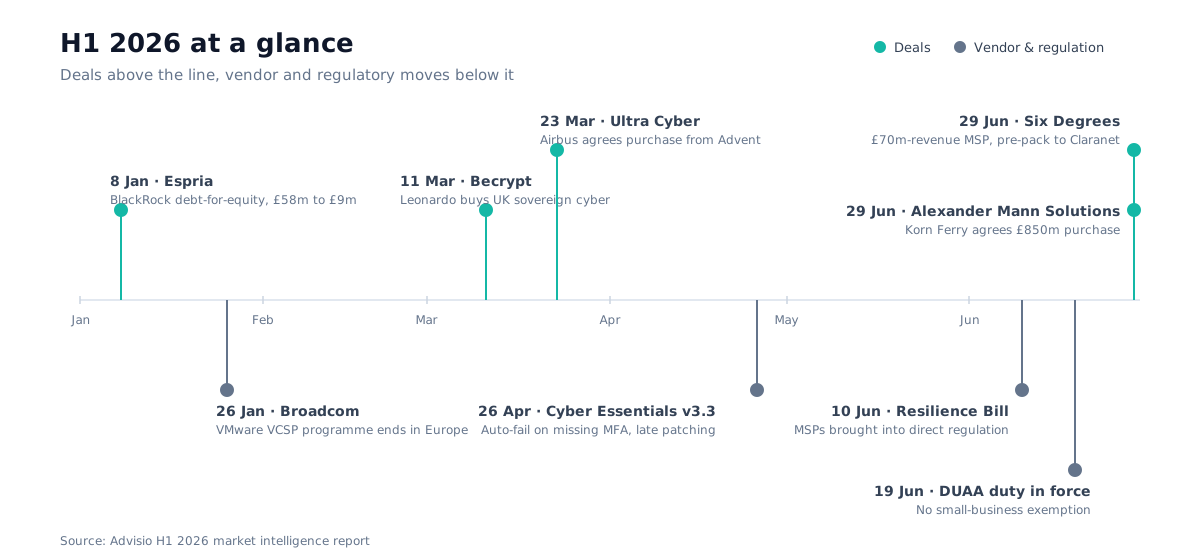
H1 2026 at a glance: deals above the line, vendor and regulatory moves below it.
The money didn't leave. It got picky.
If H1 were a downturn the deal sheet would be thin. It wasn't. The UK recorded 24 disclosed IT services and MSP transactions in the half, most of them bolt-ons. Redsquid did four on its own, including Partnership Education, its largest ever, on the way to a stated £50m revenue target. Kubus hadn't bought anything in 23 years, then bought twice in two months. Everything Tech notched acquisition number nine. Aspire took out NVT Group on its way to a £100m target by 2030.
The sponsors kept writing cheques too. Bowmark bolted Chalkstring onto its construction software platform and separately bought into building-cost data. LDC backed UBDS Group, a consultancy that has grown revenue 150% in three years. Palatine ran its OryxAlign process through the half. Hg put £357m to work through its listed trust over the year and is pushing generative AI across more than 60 portfolio companies as a value creation lever. Behind them sits roughly £190bn of UK-managed dry powder, and Grant Thornton reports 70% of private equity firms plan to invest more this year, not less.
Now set that against KPMG's number: UK technology, media and telecoms deal volume fell 24% year on year in 2025, the sharpest decline of any sector. Abundant money, fewer deals. That combination has one explanation. Buyers got picky.
Hampleton's half-year report says buyers no longer pay for "storylines" or headcount-led growth. Pricing now anchors to execution certainty, margin transparency and integration readiness.
That sentence should be pinned above the desk of anyone planning a sale. The market has stopped marking homework on ambition and started marking it on evidence. Every sale process I've been close to recently was won or lost in the data room, not the vision deck.
One sector, two markets
The listed names tell you exactly what is being rewarded, because the dispersion this half was brutal.
Computacenter's adjusted profit before tax roughly doubled to around £163m and the shares jumped 10.7% on results, driven by hyperscale and AI infrastructure projects. Softcat grew half-year revenue 53.5% to £837.5m and raised guidance. Kainos grew Workday ARR 23% to £89m, with £65m of AI-related public sector contracts signed.
Then there's FDM Group. Revenue down 31% to £97.3m, the shares down 51.5% over the year, trading at 8.7 times trailing earnings. That is not a market in a bad mood. That is a verdict on renting out people by the head at the exact moment buyers decided they want outcomes instead.
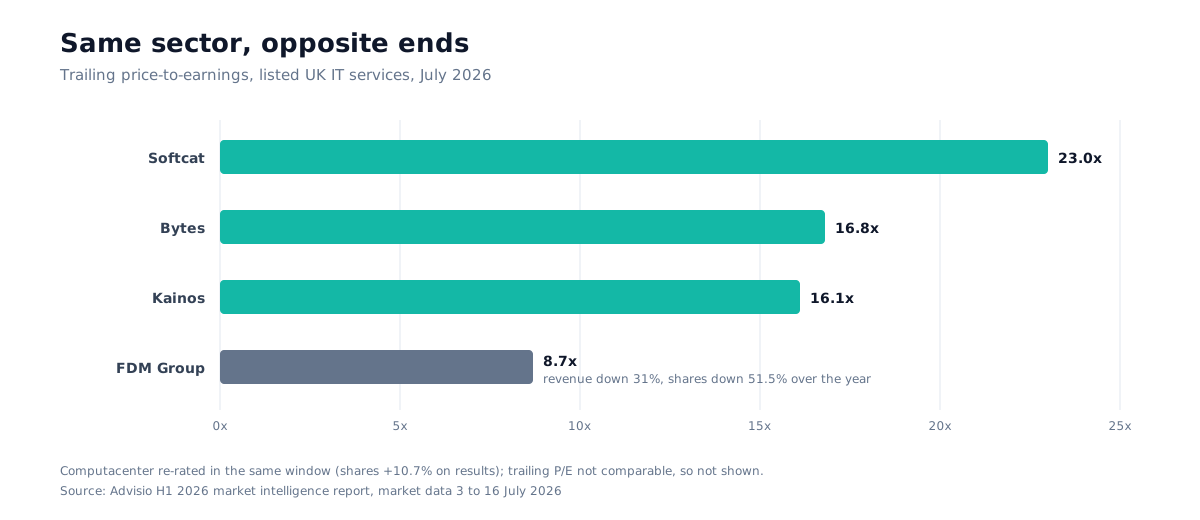
Same sector, opposite ends. Trailing P/E, July 2026.
Notice what separates the two lists. Not claiming AI. Everyone claims AI. Computacenter and Kainos get paid because AI shows up in delivered projects, services revenue and ARR. The punished names hold licence-resale margin or bench headcount. Bytes sits in between as a warning: gross margin slid from 7.8% to 7.1% the moment Microsoft moved its incentives.
The same sort runs through private markets, where it has hard numbers attached. UK MSPs trade between roughly 6 and 13 times EBITDA, with the median around 8 to 9. Cross 70% managed recurring revenue and you trade 1.5 to 3 turns higher. Add credible cybersecurity specialism and there is another 1 to 2 on top.
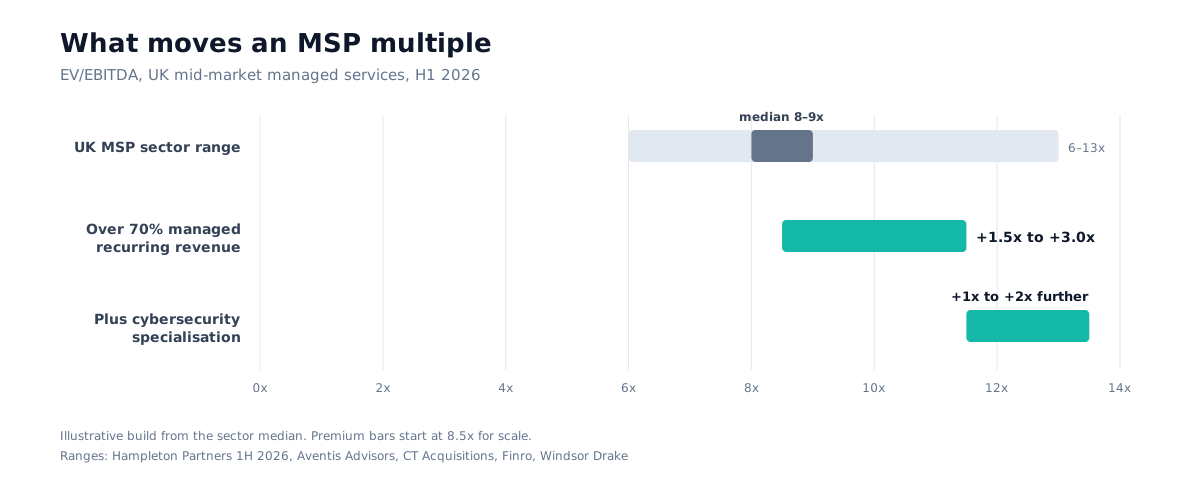
What moves the number: recurring revenue quality first, security capability second.
That 70% line is worth more than any AI slide in your deck. Revenue quality used to be a diligence footnote. It's now the price.
The vendors are running the sort from above
The most disruptive thing that happened to the UK channel this half was not a deal. It was Broadcom terminating the VMware Cloud Service Provider programme across Europe from 26 January. Hundreds of European providers lost renewal rights. Partners report cumulative cost increases above 1,000% through the price rises, bundling and minimum commitments that preceded the cut-off, and resale margins compressed from 10-15 points to 5-6. CISPE has a formal competition complaint in front of the European Commission, which tells you how warmly the whole thing landed. If you run a VMware-based hosted or private cloud practice, the decision has already been made for you. What's left is picking the migration path and the date.
Microsoft applied the same pressure with better manners. The direct-bill threshold for Cloud Solution Providers tripled to $1m, the distributor club was cut from around 180 members to 60, and the FY26 incentive framework moved to a 60/40 rebate and co-op split gated behind capability points, applied retroactively from July 2025. Repricing a year partners have already traded takes a certain confidence. UK commentary settled on a phrase that deserves to outlive the half:
"Too big for indirect, too small for direct."
That is the mid-tier partner squeezed from both sides at once, and it describes a lot of businesses currently sitting in bolt-on pipelines.
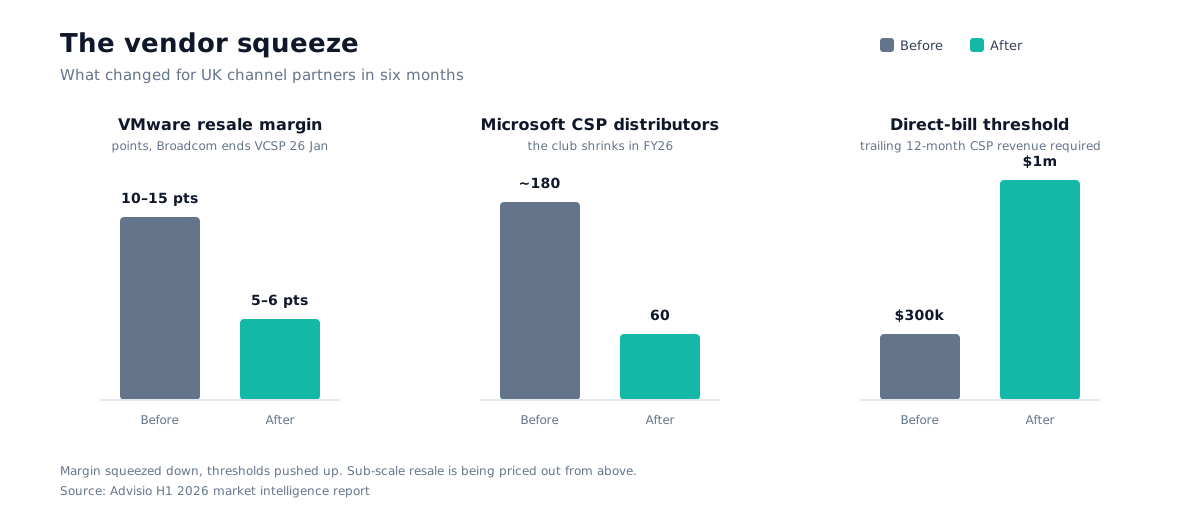
Squeezed from above: what changed for partners in six months.
The operator translation is simple. Pure resale is being de-monetised from the top of the value chain. The maths on the fix is known: roughly one turn of EBITDA for every ten points you shift services' share of gross profit. If a meaningful slice of your revenue is still box-shifting, the vendors have made your strategic decision for you. The only question left is timing.
You're no longer selling compliance. You're subject to it.
Something changed in the regulation this half that hasn't sunk in across the sector yet. The Cyber Security and Resilience Bill, through the Commons on 10 June and now in the Lords, brings MSPs and data centres into the regulated category of "relevant digital service providers" for the first time. That means 24-hour initial incident reporting, 72-hour full reporting, and turnover-based fines. The MSP moves from selling compliance to being the regulated entity.
Around it, the deadlines stacked up. Cyber Essentials v3.3 has auto-failed missing multi-factor authentication and late patching since 26 April. The Data (Use and Access) Act's complaints-handling duty landed on 19 June with no small-business exemption, while PECR fines rose from a £500,000 cap to £17.5m or 4% of global turnover. And on 10 July, HM Treasury made its first Critical Third Parties designations: Microsoft, AWS, Google Cloud and Oracle, now under direct Bank of England, PRA and FCA oversight. Cloud concentration advisory for financial services clients is a service category that did not exist in January. Give it a year and it will have its own conference.
The demand side is real. Kaseya finds 71% of MSPs growing cybersecurity revenue year on year. vCISO engagements run £1,500 to £8,000 a month at 55-65% gross margin. And the widest gap in the sector is sitting in plain sight: 48% of providers say AI and automation is their clients' top ask, but only 13% earn meaningful revenue from it. The distance between those two numbers is mostly PowerPoint. Deadline-driven compliance is the strongest demand engine the channel has had in years, and most providers are still selling it as a favour rather than a product.
But here is the dot most people haven't connected. Being regulated is a fixed cost, and fixed costs favour scale. The same sub-scale generalist that Microsoft and Broadcom just priced out of viable vendor economics now needs audit-ready, evidenced controls as a regulated entity. Squeezed on vendor margin from one side and compliance cost from the other, the sub-£10m generalist MSP is being pushed towards a choice: specialise, sell, or subcontract.
You can smell an exit window in the hiring
Five private equity-backed or listed MSPs changed chief executive inside two quarters, Kerv, Nasstar, Roc Technologies and Communicate Technology among them. Specialist recruiter Robertson Sumner calls it "record-level channel churn". These were orderly, board-directed successions, and that is exactly what makes the pattern interesting.
Kerv's co-founders left in January; by April the business had an external CEO from outside IT services entirely. Communicate Technology moved its founder to a non-executive seat and hired a chief executive who has already done the zero-to-£190m, three-private-equity-rounds run once. Redcentric hired a CFO on a fixed-term contract specifically to execute the £122.85m sale of its datacentre business, completed the deal on 30 April, and had a new CFO in the seat on 1 May. Made Tech hired a CFO whose defining previous achievement was selling a private equity-backed IT services business. Seven CFO appointments this half were tied to completed or pending transactions.
I've watched this choreography from the inside. Founders step back, a scale-and-professionalise CEO arrives, a transaction-experienced CFO follows, the board fills out. Nobody writes "we're selling in 18 months" in the press release, and nobody needs to. Boards are treating finance leadership as deal infrastructure, and it points at a crowded 2026-27 exit and refinancing window.
Nobody printed a multiple
The quietest big fact of the half: not one completed UK IT services transaction disclosed a full revenue or EBITDA multiple. The only pricing that surfaced was Planet IT's target financials and AccessPay's roughly 2.5x return for an exiting investor. Everything else stayed private.
If you're wondering how that squares with the numbers I quoted earlier, the 6-to-13x range and the recurring-revenue premium, good, you're paying attention. Those come from the advisory firms, Hampleton and the like, who sit inside enough transactions to publish blended ranges without naming anyone. That data is real, and worth calibrating against. It is also not a comp. "Somewhere between 6 and 13" is a weather forecast, not a price.
To be clear about the secondaries, too: private equity selling to private equity is not news. Sponsors have been passing parcels to each other since the industry was invented, and Bowmark and Bridgepoint handing Helio Intelligence to ECI, or ECI buying Paragin from Main Capital, is normal traffic. What has changed is everything around it. Trade buyers are scarcer, and the listed comps have split too wide to anchor a private mark. Take those reference points away and sponsor-to-sponsor deals are where mid-market prices are being set, and neither side of one has the slightest incentive to publish the number. The pricing knowledge is all in the room, and the room is small. The market is marking its own homework and keeping the answers in a drawer.
The two big prints of the half sit outside core IT services altogether: Korn Ferry's £850m agreed purchase of Alexander Mann Solutions, and EQT's £10.9bn take-private of Intertek at a 40% premium. Business services and testing. That tells you where confident large-cap pricing currently lives, and it isn't here.
If you're selling into this market, understand what that means. There is no visible comp to point at. The buyer, who was probably in the room for the last three deals, knows more about clearing prices than you do. In that market, the seller who arrives with audited recurring-revenue quality, a clean margin bridge and integration-ready data sets the anchor. The seller who arrives with a story gets anchored.
The quiet exit door that opened
One route did get clearer this half, and it barely made a headline. On 11 March, Leonardo bought Becrypt, a UK firm doing secure endpoints and data transfer for government. Twelve days later, Airbus agreed to buy Ultra Cyber from Advent International. Two defence primes, two sovereign UK cyber assets, a fortnight apart.
Neither deal disclosed a price, and I'd argue that is the point. Defence primes buy capability and sovereign assurance, not EBITDA arithmetic. They pay for scarcity: clearances, accreditations, hosting that stays inside the country. That is a different buyer set from the financial sponsors haggling over recurring revenue percentages, and it clears at a different price.
If you hold or back a UK cyber business, the question worth asking is whether 18 months of investment in defence-grade accreditation moves you out of the crowded MDR services queue and into that corridor. Entry-tier MDR is already price-competed. Strategic scarcity is not.
What I'd do about it
If you own or run one of these businesses. Know your managed recurring percentage to the decimal, because the 70% line is worth 1.5 to 3 turns of EBITDA. Price your VMware and Microsoft exposure this quarter, not after renewal. Stand up an evidenced compliance offer while the deadlines are still doing your selling for you. And if an exit sits anywhere in your next 24 months, start building the evidence pack now, because the hiring patterns say the queue for 2027 is already forming, and you don't want to be the fourth near-identical MSP through the door that quarter.
If you back them. Stress-test covenants on anything bought with 2019-2022 money against today's rates, and decide whether each asset is an exit, a refinance or a hold before the facility decides for you. Espria and Six Degrees are two data points. A third Companies House filing inside twelve months makes it a trend, and reprices the debt behind every geared platform in the sector.
What I'm watching in H2: whether that third distress case lands. Whether IRIS Software Group finally starts a process and hands the whole market a reference print. Royal assent on the Resilience Bill and what its transitional guidance costs newly in-scope MSPs. And whether a third defence prime follows Leonardo and Airbus into sovereign UK cyber, because two acquisitions in a fortnight was not a coincidence.
None of this reads like a market in trouble to me. The demand is there and the capital is waiting. What has changed is that every referee on the pitch, buyer, vendor and regulator, is now checking the same thing: can you prove what you say you are? The businesses that can are being paid premiums. The ones that can't are meeting the administrator, or the anchor.
H1 didn't punish scale. It punished pretending.
This is Advisio's read on the H1 2026 UK IT services and SaaS market, drawn from our half-year market intelligence report. Every figure above is sourced in the full report. If you want the working behind any of it, ask.